
Why Newsprint Is Finding a New Life Inside Parcels and Packaging
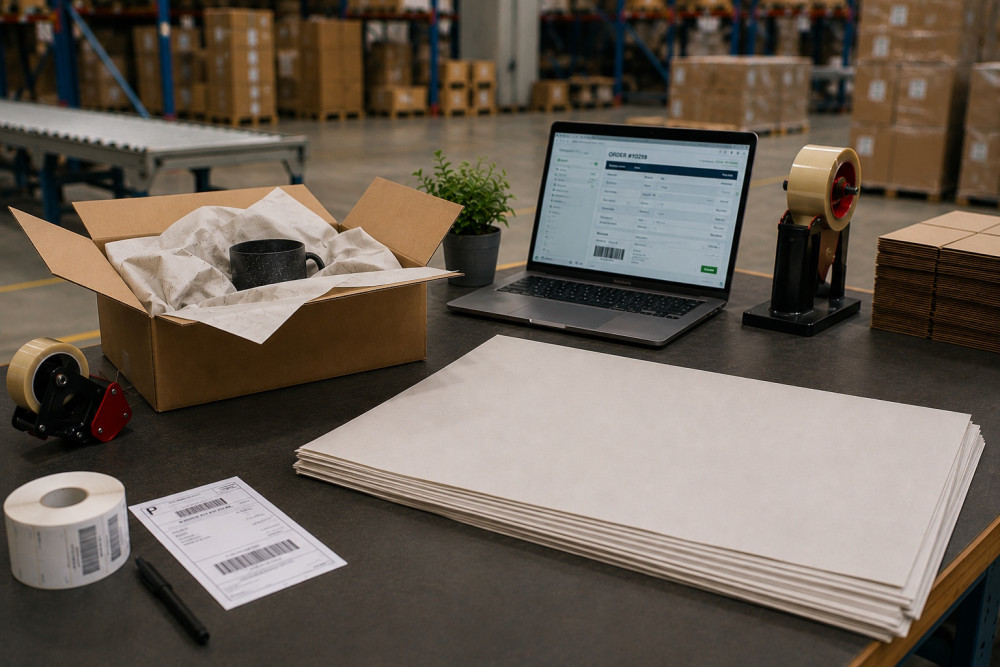
Best known as the paper of newspapers, newsprint lends itself naturally to these less conspicuous tasks because many of the qualities that once made it practical for high-volume publishing are equally useful when products need lightweight protection. It is flexible and easy to fold or crumple, while its fibre-based composition allows it to enter established paper recycling streams after use. At the same time, its limitations help define where it makes sense: as an uncoated paper, it is not intended for wet or grease-intensive applications, but many dry goods travelling through storage and transport simply do not require those additional properties.
Newsprint's move into packaging is therefore less a story of reinvention than of finding another use for familiar characteristics. A material does not always need to acquire new properties to remain relevant; sometimes a new application emerges because the properties it already has happen to answer a different need.
Printed Newsprint: From Newspapers to Protective Wrapping
One quality in particular provides a link between newsprint's traditional and newer roles. Even when its main purpose is to wrap, separate or cushion products, it remains a printable surface, which means that protective paper can also carry a logo or other simple marking without requiring a separate component solely for that purpose.
The paper itself determines what works well. Because newsprint is uncoated and slightly absorbent, clear, contrasting designs are better suited to its surface than intricate detail, while flexographic printing provides a way of applying such designs in larger production runs. The result is still an uncomplicated piece of protective paper, but one whose existing characteristics allow it to perform more than one function.
That combination of simplicity and usefulness is easy to see in the finished package. What is far less visible is everything that has happened before the paper reaches it, from the sourcing and traceability of fibre to the energy and processes used in production. Looking at newsprint only as the sheet found inside a box therefore tells only part of its story.
Paper Packaging: Fibre Sourcing, Certification and Production
Many of the environmental considerations surrounding paper packaging leave no obvious trace on the material itself. Two sheets may look much the same while having been produced within very different systems for sourcing materials, managing production or documenting what happens along the supply chain. This is where certification and audited management systems add information that cannot be gathered simply by looking at the finished paper.
Lasse Borg, CEO of Carccu®, a Finnish paper packaging manufacturer and flexographic printing house that supplies newsprint paper under FSC® Chain of Custody and PEFC Chain of Custody certifications and operates under ISO 9001 and ISO 14001 management systems, sees external verification as an important part of that process.
"Certification is proof through an external audit that we operate responsibly."
The point reaches beyond certification itself. Discussions about packaging often concentrate understandably on what happens at the end of its useful life, particularly whether a material can be recycled, but the route to that point begins much earlier. Fibre sourcing, energy, printing and the handling of production side streams all belong to the same wider picture, even though none is immediately apparent to the person opening the parcel.
Seen from that perspective, the apparent ordinariness of newsprint becomes rather interesting. The material itself can remain simple while the decisions surrounding its production, use and eventual disposal are considered much more carefully.
Choosing Newsprint for Different Packaging Needs
That does not mean newsprint is the answer to every packaging problem, nor does it need to be. Packaging has to respond first to the product it is protecting: some applications require resistance to moisture or grease, greater strength or other specialised properties, while a dry item that merely needs wrapping, separation or light cushioning presents a much simpler set of requirements.
The more useful question, then, is not how many properties can be built into a packaging material, but which ones are actually needed. Additional performance is valuable when the application calls for it; where it does not, adding complexity does not automatically produce a better fit.
Newsprint illustrates that principle particularly well because its role in packaging depends largely on characteristics it has possessed all along. Its low weight, flexibility, printability and ease of handling have simply found another setting in which they are useful, turning a material strongly associated with one industry into a practical part of another.
That kind of reassessment is likely to remain relevant as packaging requirements continue to evolve. Changes in regulation, production practices and customer expectations can alter what is required of familiar materials, while manufacturers have to adapt without losing sight of the practical job packaging is there to perform. Borg, whose company also manufactures and prints other paper packaging products, describes that capacity to respond to change in straightforward terms:
"When we do our best, I trust that it will be enough; we are capable of rapid changes, so we can keep pace with the world," Borg says.
Newsprint's journey from newspapers to parcels is a modest example of that broader process. Innovation may sometimes mean developing an entirely new material or technology, but it can also begin by looking again at something familiar, understanding its strengths and limitations, and recognising where those existing qualities still have a useful job to do.
New stoke Jobs Section Launched!!
Vacancies updated hourly!!
Click here: stoke jobs
Share: