Many of Britain's overlooked insects becoming more abundant, study with Keele scientists finds
By Nub News Reporter 11th Nov 2026


Local scientists have helped uncover evidence that many of Britain's overlooked insects and spiders are becoming more abundant and emerging earlier in the year.
Led by scientists from Keele University and Rothamsted Research, the team analysed more than 600,000 insects and spiders collected over three decades from four long-running monitoring sites across England.
The new study, published in the Global Change Biology journal, focused on what the team calls "Cinderella species".
These are small, often ignored creatures such as fungus flies, gall midges, barkflies, beetles and ballooning spiders that play vital roles in pollination, decomposition, pest control and nutrient cycling.
The research found that most of the 71 arthropod groups studied showed stable or increasing numbers over the past 30 years, while many were also appearing earlier in the season.
A strong link was found between earlier emergence and higher abundance, suggesting that warmer conditions might be extending opportunities for some species to reproduce.
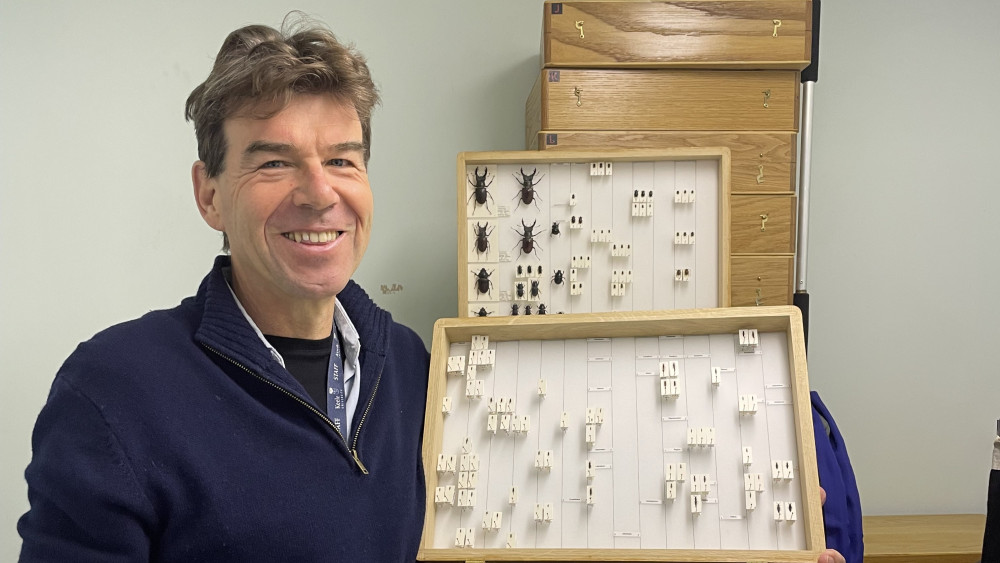
James Bell, Professor of Entomology at Keele University and co-first author to the study, said: "The work establishes an important baseline for a vast but under-recorded part of Britain's biodiversity and highlights the need to better understand the insects and spiders that quietly underpin many of the country's ecosystems.
"The findings do not mean that concerns about insect conservation have disappeared.
Download our Nub News App!
- It’s FREE and available now- Breaking news notifications
- Your Town in Your Pocket


"Our study looked at insects flying high above the ground during migration, rather than local insect populations at ground level, where declines have often been recorded.
"Instead, the results offer a different perspective on how insect communities are responding to environmental change."
The team analysed insects preserved in the Rothamsted Insect Survey archive, one of the world's longest-running insect monitoring programmes.
More than half a million previously unidentified specimens were examined.
Keele said this has provided one of the most comprehensive assessments yet of Britain's lesser-known flying insects.
Temperature emerged as the strongest factor associated with changes in both abundance and timing, with warmer conditions linked to earlier seasonal activity.
Land use also played a role, although its influence was less important than climate-related factors.
Alice Milne, co-author and Rothamsted Research mathematician, said: "The main objective was to publish insect and spider trends at the finest taxonomic resolution.

"Using a machine-learning approach, we were able to bring together these sparse records to show meaningful population-level changes - a triumph for those forgotten Cinderella insects and spiders."
The research was funded by the Natural Environment Research Council, while the Rothamsted Insect Survey is funded by the Biotechnology and Biological Sciences Research Council.
This is a sponsored article. If it wasn't for sponsors like Keele University, our news site would not be possible - thank you.
If you own a local business and would like to sponsor us, get in touch at [email protected].
CHECK OUT OUR FREE NEWSLETTER!
5 TOP STORIES EVERY FRIDAY!
Click here to sign up: stoke newsletter

Share: